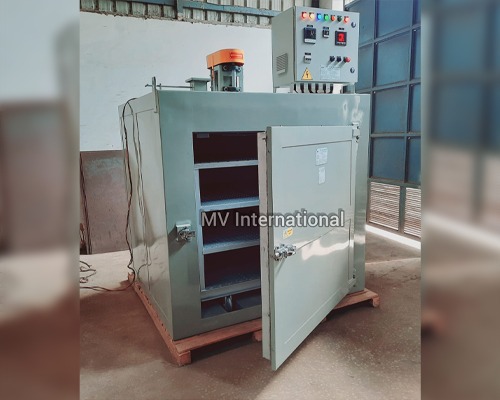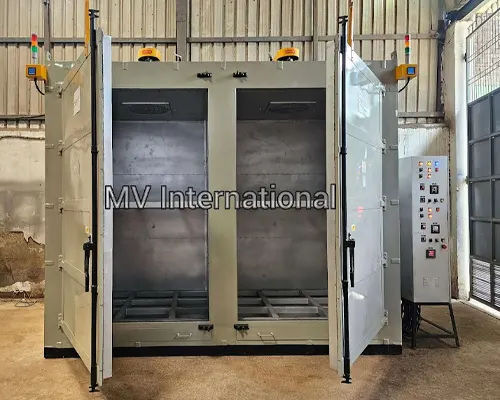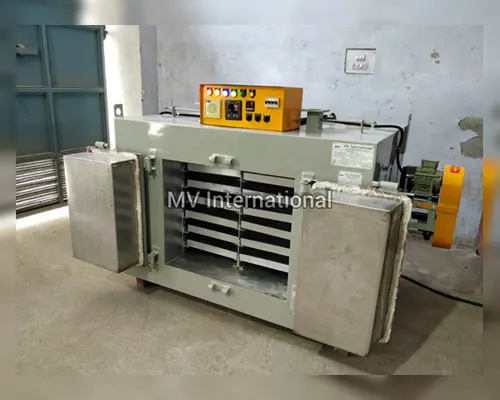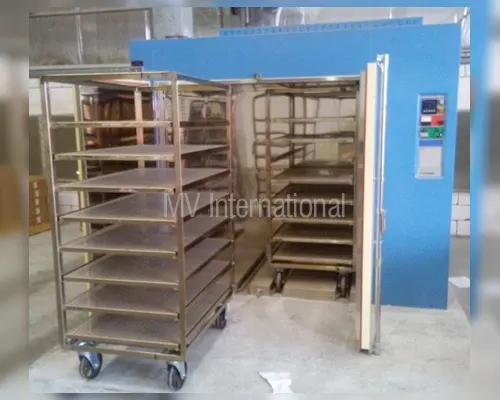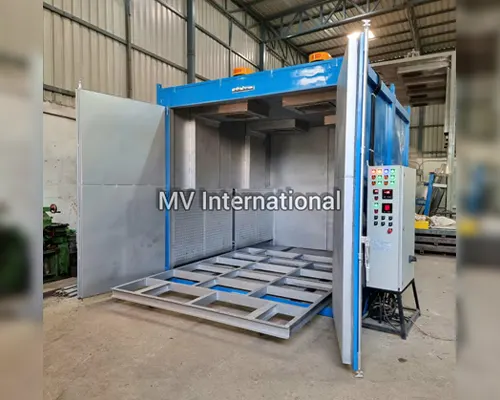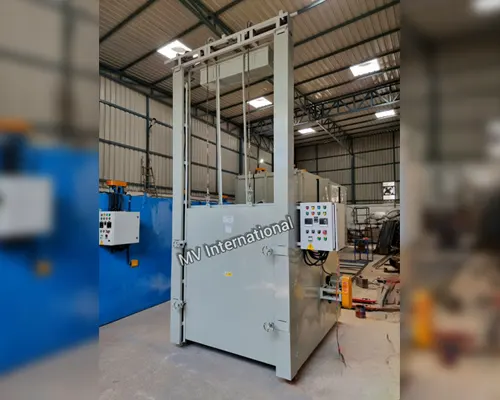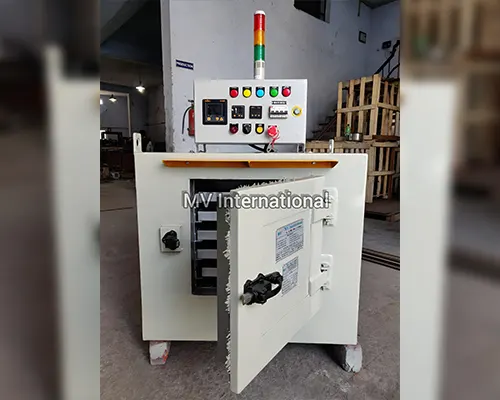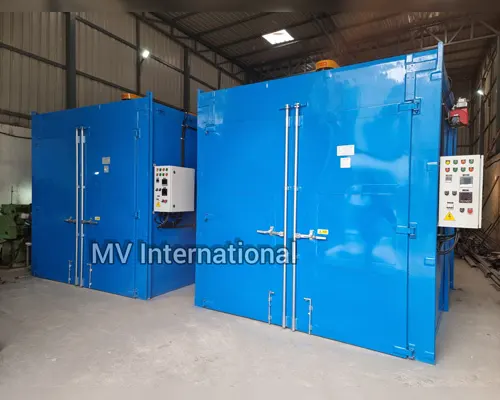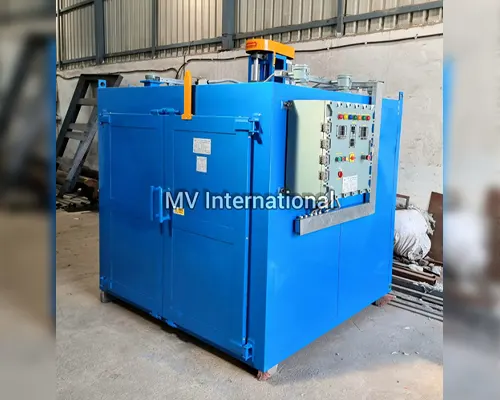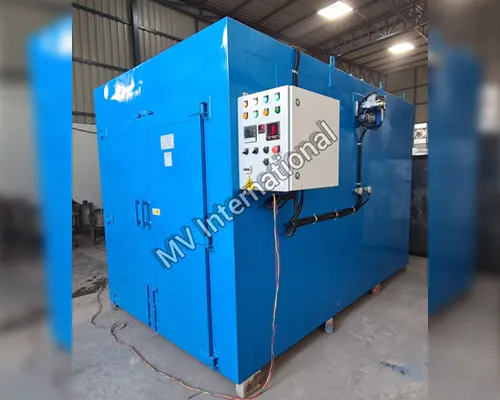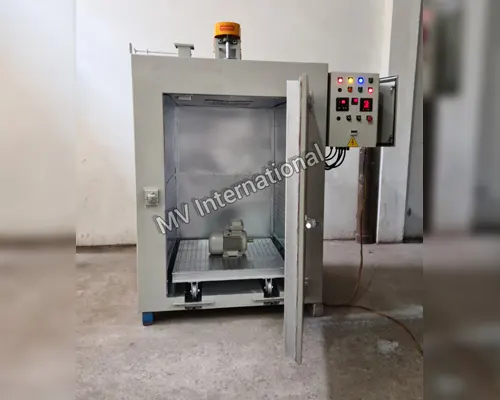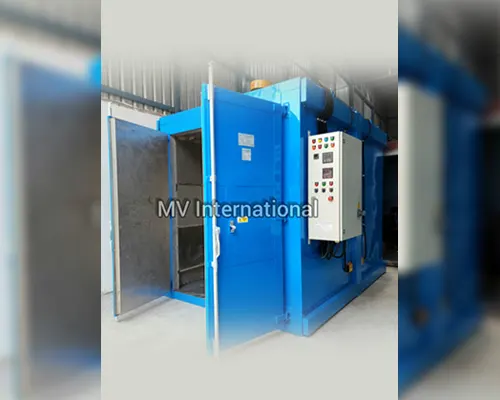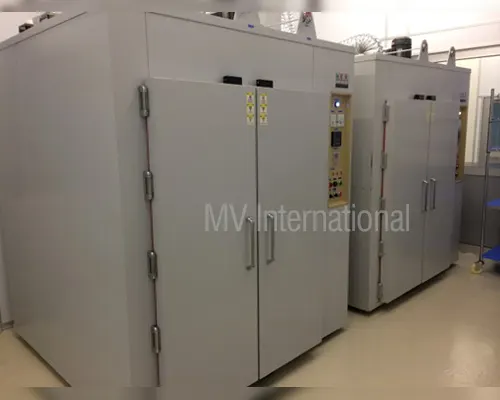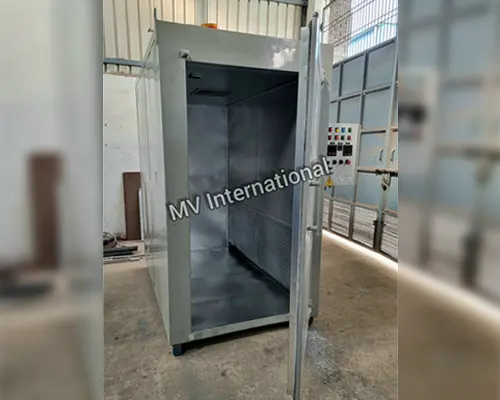
ISO-certified industrial batch ovens engineered for precise temperature control, energy efficiency, and repeatable thermal processing. Manufactured in India by MV International for global industrial standards.
Small-batch manufacturing requires absolute temperature precision to ensure quality and minimise material waste. MV International designs robust industrial batch ovens that deliver consistent thermal processing for curing, baking, drying, and tempering applications across diverse sectors.
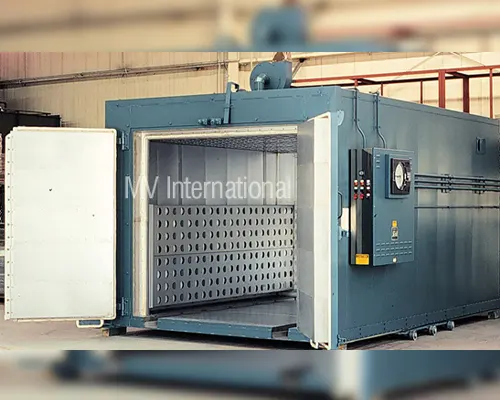
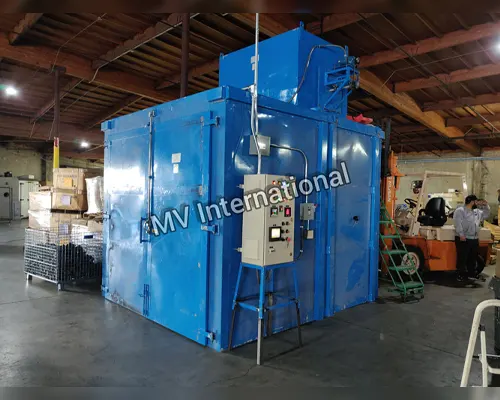
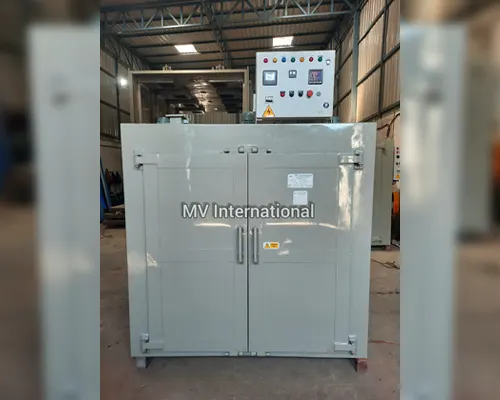
An industrial batch oven is a thermal processing unit designed to heat products in specific, enclosed groups.
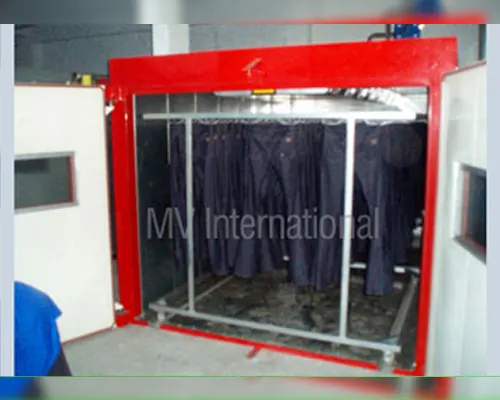
Operators load a batch, such as coated metals, motor armatures, or rubber moulds, into the chamber. The system then executes a highly controlled, pre-programmed thermal cycle consisting of heating, soaking, and cooling phases. Once the cycle completes, the batch is removed. This setup allows manufacturers to process highly customised heating profiles independent of their main continuous production lines.
Our industrial batch ovens are built to solve real-world shop floor challenges. Key advantages include:
When specifying a thermal system, we configure the oven based on your exact processing requirements:
Select the right oven architecture based on your production volume and operational requirements.
| Feature | Industrial Batch Ovens | Continuous (Conveyor) Ovens |
| Ideal Production Style | Small-to-medium batches and prototype testing. | High-volume, non-stop mass production. |
| Process Flexibility | High. Easily change temperature profiles between different batches. | Low. Locked into a single thermal profile continuously. |
| Facility Footprint | Compact. Integrates seamlessly into existing shop floors. | Large. Requires extensive space for long conveyor belts. |
| Investment Level | Lower initial capital investment. | High initial capital and installation costs. |
| Maintenance | Straightforward; direct access to the internal chamber. | Complex; requires servicing moving belts and drives. |
MV International manufactures customisable batch ovens to accommodate varied tray layouts, heavy fixtures, and precise thermal requirements across multiple industries.
Primary Industrial Applications:
Key Industries We Serve:
Small-batch units need flexibility without process drift.
Industrial batch ovens allow manufacturers to run controlled cycles without resetting the entire line. Each batch follows a defined heating profile, reducing variation across samples. This suits research units, specialised coating lines, and export-focused production facilities.
Another reason is space efficiency. These ovens integrate into existing layouts without forcing structural changes. Operators gain precise temperature zones, stable airflow, and predictable results. This balance supports careful production planning while protecting material integrity across batches.
Consistency depends on repeatable thermal behaviour.
These ovens distribute heat evenly through calibrated airflow paths. This prevents hotspots that damage sensitive components or coatings. Each batch receives the same thermal exposure, regardless of load size.
Control panels allow operators to store proven heating cycles. Once validated, the same programme can run again without adjustments. This discipline supports audit compliance, export quality standards, and customer confidence. Over time, reduced rework directly supports lower operational cost.
Versatility comes from controlled design, not complexity.
Industrial batch ovens handle curing, drying, ageing, and stress relieving tasks across automotive, electrical, defence, aerospace, and chemical sectors. The chamber design supports varied tray layouts, fixtures, and load weights.
Temperature ranges remain stable even during frequent door operations. Insulation quality protects energy efficiency while keeping external surfaces safe. This adaptability allows manufacturers to serve diverse client requirements without owning separate heating systems for each application.
Energy use matters when margins are tight.
Modern industrial batch ovens use insulated panels and balanced airflow to reduce heat loss. Heat recovery systems reuse residual warmth within the chamber. This lowers power demand during each cycle.
Smart controllers prevent overheating and unnecessary dwell time. Operators heat only what the process requires. Over long production runs, these savings accumulate quietly, supporting sustainability goals without altering production speed or quality expectations.
Export clients demand documentation and repeatability.
Industrial batch ovens support traceable heating records. Temperature logs, cycle histories, and alarms help meet international compliance norms. This is critical for exporters working under strict quality audits.
Stable construction ensures long service life even under continuous operation. This reliability reduces unplanned downtime, protecting shipment timelines. For manufacturers serving overseas markets, dependable thermal processing strengthens reputation and client trust.
Design decisions follow process reality.
MV International studies client workflows before finalising oven configuration. Chamber size, airflow direction, loading pattern, and control logic align with real production needs. This prevents overdesign and avoids operational strain.
Build quality remains consistent across units. Heavy-duty frames, reliable heating elements, and calibrated sensors support long-term stability. Export packaging, installation guidance, and documentation remain structured, supporting international deliveries without friction.
Clear communication continues beyond delivery. Clients receive guidance that supports correct use, maintenance planning, and process discipline. This approach values long-term partnership over short-term output.
Small teams need predictable tools.
Our industrial batch ovens remove reliance on manual monitoring. Automated alarms and cut-offs protect both product and operator. When temperature limits approach unsafe levels, systems respond without delay.
This reduces dependence on constant supervision. Teams focus on inspection, documentation, and quality control rather than fire-fighting process deviations. Over time, this stability supports skill development and confidence across operations.
Small-batch manufacturing has changed how many industries work. Orders are shorter. Quality checks are tighter. Deadlines are closer. In this environment, equipment must support control, repeatability, and calm decision-making on the shop floor. Heating processes sit at the centre of this change. When temperature control fails, the entire batch fails. This is where industrial batch ovens quietly redefine how manufacturers plan, test, cure, dry, and finish products. At MV International, our focus stays clear: build ovens that respect process discipline, reduce waste, and support consistent outcomes for manufacturers who cannot afford uncertainty.
Small batch manufacturing demands absolute temperature precision to guarantee product quality and minimize waste. An industrial batch oven is designed to deliver exactly that. Whether your process involves curing, baking, drying, or tempering, these ovens handle small to medium production runs with exceptional flexibility.
As a well-known Batch Oven Manufacturer, MV International engineers robust thermal processing equipment that integrates seamlessly into your existing shop floor. Our ovens provide the control and consistency required to achieve perfect results across every single load.
Unlike continuous conveyor systems that run a single temperature profile for large volumes, a batch system allows you to easily switch temperature settings between different product runs. This flexibility is vital for facilities that handle multiple components in a single day.
The enclosed and insulated chamber retains heat efficiently, while high velocity airflow ensures uniform temperature distribution. This combination eliminates cold spots, guaranteeing that every piece in the batch receives the exact same thermal treatment from the surface to the core.
We design each oven around the exact thermal requirements of the materials you process. Our standard builds include:
Achieving rapid and uniform heat transfer requires smart airflow design. We configure our ovens with vertical, horizontal, or combination airflow patterns based on the geometry of your load. High volume fans provide double the air changes of standard industrial ovens. This drives moisture out faster and cures coatings much more evenly.
As leading Batch Oven Manufacturers in India, we go beyond basic heating by integrating optional automation like PLC and SCADA systems. This technology allows your operators to monitor data, adjust heating profiles, and track machine performance from a single centralized interface.
The versatility of our batch heating systems makes them a true cornerstone in multiple sectors:
A reliable machine starts with rigorous testing. We test every single unit at our facility before it is ever dispatched. You receive complete technical drawings, wiring schematics, and test certificates so your maintenance team knows exactly how the machine operates on site.
As established Batch Oven Suppliers in India, we hold ourselves to honest lead times. If a custom build takes several weeks, we communicate that upfront. We also maintain a solid stock of spare parts, ensuring that a simple component failure never brings your production line to a standstill.
Our reach extends far beyond domestic borders. Operating as dedicated Batch Oven Exporters in India, we regularly ship equipment to clients across the Middle East, Africa, Southeast Asia, and Europe.
We build units matched exactly to your destination voltage and frequency. Every machine is securely packed for rough international freight and accompanied by flawless customs documentation to prevent border delays. Most importantly, our engineers remain accessible for technical support long after the oven is installed and commissioned.
Getting the most out of your oven starts with proper sizing. Just tell us the material you are processing, the physical dimensions of your load, your target temperature, and your heating medium preference. From those details, our technical team will calculate the optimal chamber size and exact power requirements to prevent energy waste.
Ready to upgrade your thermal processing? Contact our experts today to discuss your next industrial oven. Call +91 9718290000 or email mverma@mvinternational.com.
Are industrial batch ovens suitable for prototype production?
Yes. They support controlled testing cycles without disturbing existing production schedules or material consistency.
Can these batch ovens handle frequent batch changes?
Yes. Stored programmes allow quick switching between cycles without recalibration.
Do industrial batch ovens need specialised operators?
No. Controls remain straightforward after basic training.
How long do these batch ovens typically last?
With proper maintenance, service life often extends beyond a decade.
Are industrial batch ovens compliant with export standards?
Yes. Designs support documentation, traceability, and audit requirements.
What is the best industrial batch oven for small-scale manufacturing?
A programmable forced-air batch oven is the most effective solution for small-scale operations. It provides the flexibility to run multiple testing profiles or diverse product runs without needing to retool larger, continuous factory equipment.
How do industrial batch ovens ensure uniform heating?
They utilise engineered ductwork and high-powered blower fans to create balanced air pressure. This forced-air circulation ensures every specific zone inside the chamber reaches and holds the exact same temperature simultaneously, preventing product warping.
Are industrial batch ovens energy efficient?
Yes, modern units yield excellent energy savings. By combining high-retention thermal insulation with microprocessor-based temperature controls, these ovens prevent heat leakage and eliminate wasteful power surges.
Do you need a specialised operator to run an industrial batch oven?
No. Once an engineer programmes and saves the necessary thermal cycles into the digital controller, floor operators simply need to load the products, select the corresponding recipe, and press start. The automated PLC handles the heating phases safely.
What is the lifespan of an MV International batch oven?
Built with reinforced structural steel and premium heating elements, our industrial ovens consistently deliver over a decade of reliable service, even in high-demand manufacturing environments.
Request a Technical Consultation
Upgrade your shop floor with precision thermal processing. Contact MV International today to discuss custom dimensions, heating requirements, and pricing for your facility.
Copyright © 2026 MV International. All Rights Reserved.